
ALTERNATIVE INVESTMENTS; the “New” Form of Investment
Investment comes in various forms, and all accumulations of wealth are done or made via the investment process.
If we stop, and ask ourselves what is wealth? Or who is rich? Or who is poor? Poverty, riches nor wealth will reward us with a soothing answer nevertheless, we all have the answers in ourselves, and we as a race through institutions like the World Economic Forum (WEF), United Nations (UN)… have achieved global integration to a point of redefining the world as a true village.
Time, space and labor; have been masters that have governed man, his logic and creations to some form of synchronicity seen, felt or not. Therefore it’s safe to say to the human being; time, space and labor is the true wealth and riches.
Labor bridges between time and space: so, how do we (as a global community) or you as an individual consummate the latter and the former to make whole? The World Economic Forum “Alternative Investments 2020: An Introduction to Alternative Investments” report of July 2015 has attempted to break down the complex workings and sometimes opaque history of alternative investments.
So what exactly are Alternative Investments? Well basically these are those not part of the traditional assets such as cash, stocks or bonds.
Figure 1 as from the report shows an overview of the diverse types of investment ranging from
⁃ Traditional investments (i.e. Savings, bonds and etc.)
⁃ Tangible investments (i.e. Commodities, real estate…)
⁃ Alternative investment (i.e. VC, hedge funds and private equity)
⁃ Other investments (i.e. Art, wine and antiquities…)
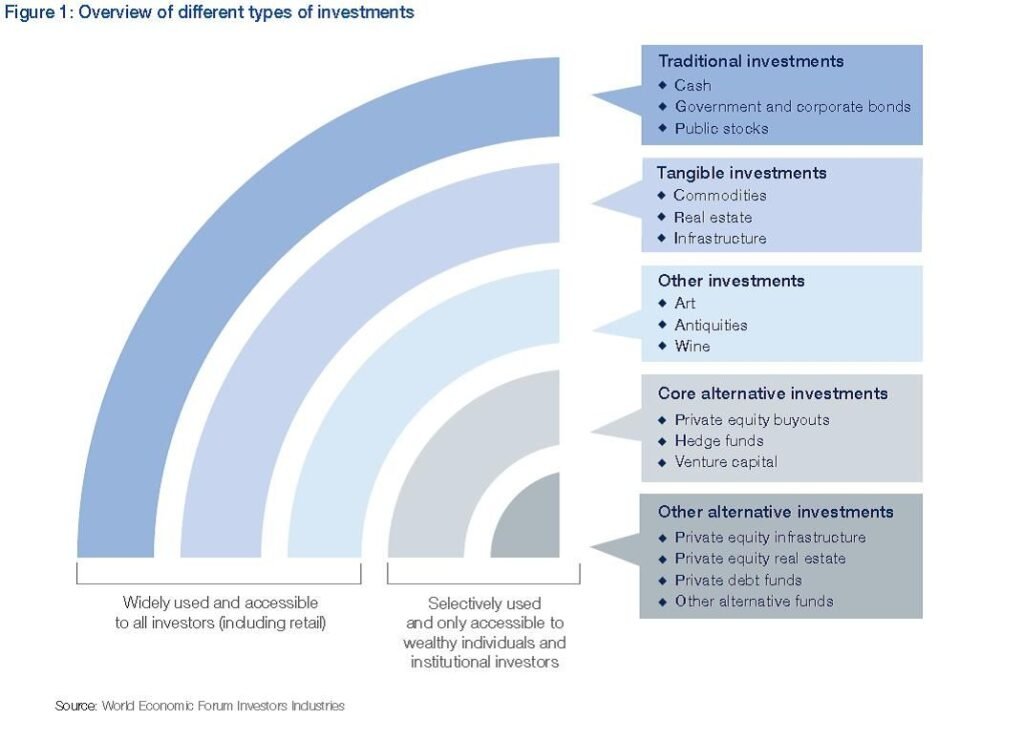
Figure 1 portrays how all these investment classes arc-in the industry spectrum and at the core of it all are the “alternative investments”. Before we get caught up in all these economic jargon let’s draw a baseline and ask ourselves what investment as a concept or diction means:
The Oxford dictionary refers to investment as “the act of devoting time, efforts or energy expecting a worthwhile result.”
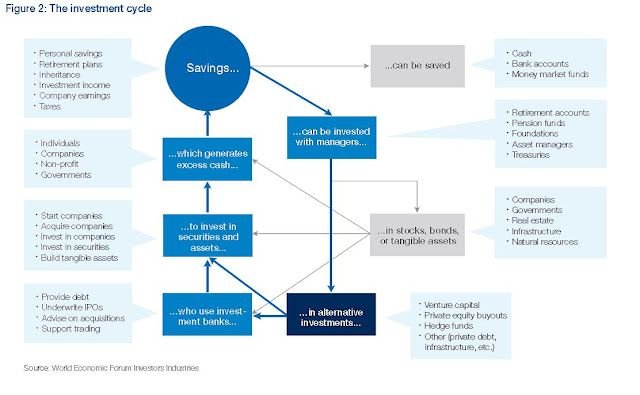
In this sense, investing is a behavior labored for, in time and space for each one and all of us to achieve our desires: poverty being the downside of all of this. The source of investments in many scenarios is savings, figure 2 as from the WEF report shows the breakdown of savings into various forms of Investments or rather the Investment Cycle as it is referred to.
Alternative investments (AI) since the 1920’s-60’s down to the present are those which have historically utilized distinctive fund structures and which only wealthy individuals and institutions have had access to. Alternatives will thus encompass a wide range of asset classes, including private equity real estate and private equity infrastructure funds, secondary funds, and private debt funds. In particular, the WEF report has focused on three asset classes: private equity buyouts, hedge funds, and venture capital. Historically, these three have played the most important role in the evolution of the industry and have accounted for the vast majority of the capital allocated to alternatives.
Private Equity Buyouts; Private equity typically refers to investment funds organized as limited partnerships that are not publicly traded and whose investors are typically large institutional investors, university endowments or wealthy individuals.
Hedge Funds; A hedge fund is an investment fund pools capital from accredited individuals or institutional investors and invests in a variety of assets, often with complex portfolio-construction and risk-management techniques.
Venture capital; This is a type of private equity, a form of financing that is provided by firms or funds to small, early-stage, emerging that are deemed to have high growth potential or which have demonstrated high growth.
In a nutshell, how do these asset classes create a worthwhile time and space for our labor so to optimize our desires?
1. Alternative investments have grown to become a critical component of the global financial system. (Through providing capital flow for liquidity, leverage, diversity and innovation)
2. Alternative investors serve capital providers with higher returns and greater diversification. (I.e. Risk to reward ratios are favorably capped attracting pension funds, sovereign wealth funds, high net worth individuals)
3. The impact of alternative investments on the real economy is substantial. Of course, not all are unambiguous but this is the tight niche fiscal and monetary regulators have to be versatile for the best interest of the public and policy.
Article Concept Submitted by; Ian Sailale amsosaiy@gmail.com
Edited by; Kapila Kavenuke kapilakavenuke@yahoo.com
The complete WEF Alternative Investment Report can be found on the link below;
http://www3.weforum.org/docs/WEF_Alternative_Investments_2020_An_Introduction_to_AI.pdf
About the Author

Excellent article Kapila very useful.
Thank you so much Sir, deeply humbled and am glad it was informative to you